Wednesday, March 31, 2010

8th Post

Roman Army Tactics

The military of ancient Rome had many techniques for fighting; offense and defense which helped them majorly to win most of their battles and wars. Their normal positions were to have the infantry in the middle and the cavalry out on the sides. The main purpose of this method was to prevent the infantry to be out smarted by the enemy flanking them from the sides then if the enemy decides to retreat the cavalry would push forward to hunt them down.

Other techniques:

The wedge was a commonly used technique by the legionaries. They would form up in a triangular shape, the top being one soldier facing towards the enemy which enables them to make 1 on 1 fighting more difficult for the enemy. It would also force the enemies to move into smaller groups which is where the gladius came in handy.
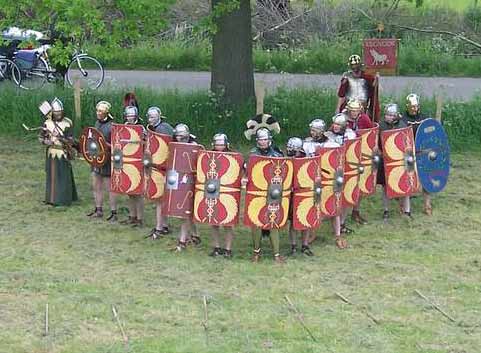


The tortoise was a great defensive method by which the legionaries would hold their shields above their heads except for the front and side rows creating a shell-like armor that would protect them from artillery made by the enemy.


Another good defensive method is the orb. It is kind of similar to the tortoise but the men in the middle don't hold up their shields and it is in a formation of a circle. This tactic is really helpful when parts of the army have been divided during battle.


References:

Websites:

The roman empire 2009, Roman Tactic, viewed 31st March 2010
[http://www.roman-empire.net/army/tactics.html]

Word Press 2010, Ferrel's travel blog, soldier picture, viewed 31st March 2010
[http://ferrelljenkins.files.wordpress.com/2008/04/soldiers_54sm.jpg]

The roman empire, 2009, legionaries picture, viewed 31st March 2010
[http://www.roman-empire.net/diverse/pics/corbridge-legionaries/orb-01.jpg]

Fectio 2008, the wedge formation, viewed 31st March 2010
[http://www.fectio.org.uk/shows/vechten2004drill2.jpg]

Monday, March 22, 2010

7th Post

I have found some more intriguing information about the roman army recently about how they train, the discipline required and the clothing/equipment they used.

Physical Training:

• Marching (every month soldiers had to march 29.6 km in less than 5 hours carrying heavy armor and weapons which weighed around 60 pounds)
• Running
• Long and high jump training
• Swimming (All recruits were made to swim if their campsite was near a sea or lake)
• Chopping down trees
• Obstacle courses

Weapon Training:

After the soldiers completed their physical training, they were required to practice how to handle and use weapons more accurately. They mainly used wooden swords and wickerwork shields that were twice as heavy as the original weaponry. Soldiers performed many attacking techniques with their sword against a wooden stake that was dug into the ground which would eventually help them improve their skills. When a soldier believes they are ready for a moving target they are allocated with another soldier were they both have a 1v1 battle. Once a warrior learns how to use heavy weapons correctly, they become twice as efficient when they are using the real ones.

Discipline:

The leader of the group would walk around with a very thick stick that was used to beat up people not following their task. All soldiers had to carry out their responsibilities or else they get punished by getting flogged or receiving a fine. If someone did something really bad like mutiny then the Centurion would walk around slaughtering every 10th man he touches including the one who committed the crime.

Clothing and Equipment:

Every Roman warrior had to wear leather sandals, breeches and wool tunic around their legs. Body armor, shoulder plates and a bronze helmet were the only armor they wore to protect them. For their equipment each soldier carried a sword, shield, 2 javelins and used a dagger for close combat.


Roman Soldier

References
:

Websites:

LearningAlive 2010, The Roman Army, viewed 22nd March 2010
[http://atschool.eduweb.co.uk/nettsch/time/rarmy.html]

History on The Net 2010, The Romans - The Roman Army, viewed 24th March 2010
[http://www.historyonthenet.com/Romans/roman_army.htm]

The Roman Empire 2009, Military Training, viewed 24th March 2010
[http://www.roman-empire.net/army/training.html]


6th Post

Grr. haven't been able to post much lately due to the Cyclone. Didn't do too much damage but we had no power for a long time. Hoping to do some work today since there is no school :)

Anyway, PeaceOut

Saturday, March 20, 2010

5th Post

Roman Army

I've had a look at some of the sites that (deb.langford)'s posted and found some interesting information.

One of Rome's special attributes was their army. Without them Rome would not be what it is now. The soldiers were divided into groups that all had their own purpose and different way of serving the Roman Empire. Legions are groups containing around five thousand men and are divided into ten cohorts which are divided into six centuries which was then separated into ten groups of eight soldiers that worked and fought together. The leader of the century was a Centurion who carried a vine stick and travelled alongside a signifer that held the Commanders badges.


References:

Websites

LearningAlive 2010, The Roman Army, viewed 22nd March 2010
[http://atschool.eduweb.co.uk/nettsch/time/rarmy.html]

Brims 2010, The Roman Army, viewed 22nd March 2010
[http://www.brims.co.uk/romans/army.html]

4th Post

At the start of the term we began to watch a movie called Gladiator and it gave me a better understanding of how the fighting system worked in the ancient times.


References:

Websites

youtube 2010, Gladiator Trailer HD, viewed 20th March 2010
[http://www.youtube.com/watch?v=ol67qo3WhJk]

Monday, March 15, 2010

3rd Post

I have found a few sites with some useful information about Gladiators. When i first thought of a gladiator in my head i just pictured a muscly guy with protective clothing but there are actually many types of gladiators and each kind were armed differently and wielded a variety of weapons. The most common types of gladiators were Thraces, Mirmillones, Retiarii, and Secutores.


Thraces:

These people would wear a broad-rimmed helmet that would protect their entire head, a square or round shaped shield and two thigh-length greaves. Their weapon is a curved Thracian sword or the sica. These types of gladiators usually fought against mirmillones or hoplomachi.


Mirmill
ones:
The Mirmillones wore a helmet shaped like a fish as well as an arm guard. They wielded an oblong shield and a gladius. These guys were paired up with Hoplomachi or Thraces.


Retiarii:
This type of gladiator had the least amount of armor on them. The only thing that would protect them is a metal shoulder shield. They ran around carrying a dagger, a net and a long trident. Their opponents would usually be secutores or mirmillones.


Secutores:

This Gladiator also wore a helmet shaped like a fish and an arm guard. Occasionally they would have extra armor like a leg shield for extra protection. Secutores also wielded the same weapons as the mirmillones. Their opponents are retiarii.


You can find more information about other types of Gladiators in the first website reference below


References:

Websites


UNRV History 2003, Roman Gladiator Types, viewed 15 March 2010
[http://www.unrv.com/culture/roman-gladiators.php]

RPGfan 1999, Gladiator Pics, viewed 15 March 2010
[http://www.rpgfan.com/pics/gladius/art-007.jpg]

RPGfan 1999, Gladiator Pics, viewed 15 March 2010
[http://www.rpgfan.com/pics/gladius/art-011.jpg]

Pagesperso 2000, Rome images, viewed 15 March 2010
[http://pagesperso-orange.fr/l.histoire.en.kit/antiquite/rome/images_rome/thrace%20120.jpg]

Pagesperso 2000, Rome images, viewed 15 March 2010
[http://pagesperso-orange.fr/l.histoire.en.kit/antiquite/rome/images_rome/retiaire.jpg]


2nd Post

Im doing alright so far. I've found some information about Gladiators that seemed pretty interesting:

Gladiators:
  • Brought to Rome from Etruria
  • Gladiator fights were first established in 264 BC and ended by 404 AD
  • By the end of the first century AD Roman citizens were given free access to watch the gladiators fight
  • Skilled fighters
  • Fights were very popular
  • Gladiators fought in huge amphitheaters such as The Colosseum
References:

Books

John Wiley & Sons, 2005, Humanities Alive 1, Victoria Australia

Websites

Encyclopedia 2010, Gladiators, viewed 15 March 2010
[http://www.encyclopedia.com/topic/gladiators.aspx]


First Post

This is my first thread and i am worried i'm not going to complete the assignment in time. My theme for this task is Fighting in general. I've been slacking off in class a lot but now i have decided to participate and try to finish the assignment on time. I will be showing information on gladiators and the roman army and some other content like pictures, videos, etc of how Rome used to handle things in the ancient times.